
The Ultimate Guide to Crypto Trading Tips and Tricks
What Every Beginner Needs to Know Before Trading Crypto
Crypto trading tips for beginners can mean the difference between building real wealth and losing your savings in a matter of days.
Here are the most important tips to get started safely:
- Start small — Only trade money you can afford to lose completely
- Use a reputable exchange — Choose platforms with strong security, KYC verification, and a solid track record
- Never risk more than 1-2% of your capital on a single trade — This protects you even after a string of losses
- Learn before you earn — Study basic strategies like swing trading or dollar-cost averaging before putting real money in
- Set stop-loss orders — Always define your exit point before entering a trade
- Control your emotions — FOMO (fear of missing out) is the number one reason beginners lose money
- Keep records — Track every trade for both improvement and tax compliance
- Diversify — Spread risk across a few assets rather than going all-in on one coin
Cryptocurrency trading has exploded in popularity. The total crypto market cap passed $4 trillion for the first time in July 2025, drawing in millions of new traders hoping to profit from the market’s wild price swings.
But here’s the hard truth: 78% of retail investors lose money trading volatile assets like crypto. The market runs 24 hours a day, 7 days a week. Prices can move 20% in a single session. And scams are everywhere.
That does not mean you should stay away. It means you need to go in with a plan.
The good news? Consistent traders are not necessarily the smartest ones — they are the most disciplined ones.
This guide breaks down exactly what you need to know to start trading crypto safely and strategically in 2026, without needing a finance degree or years of experience.
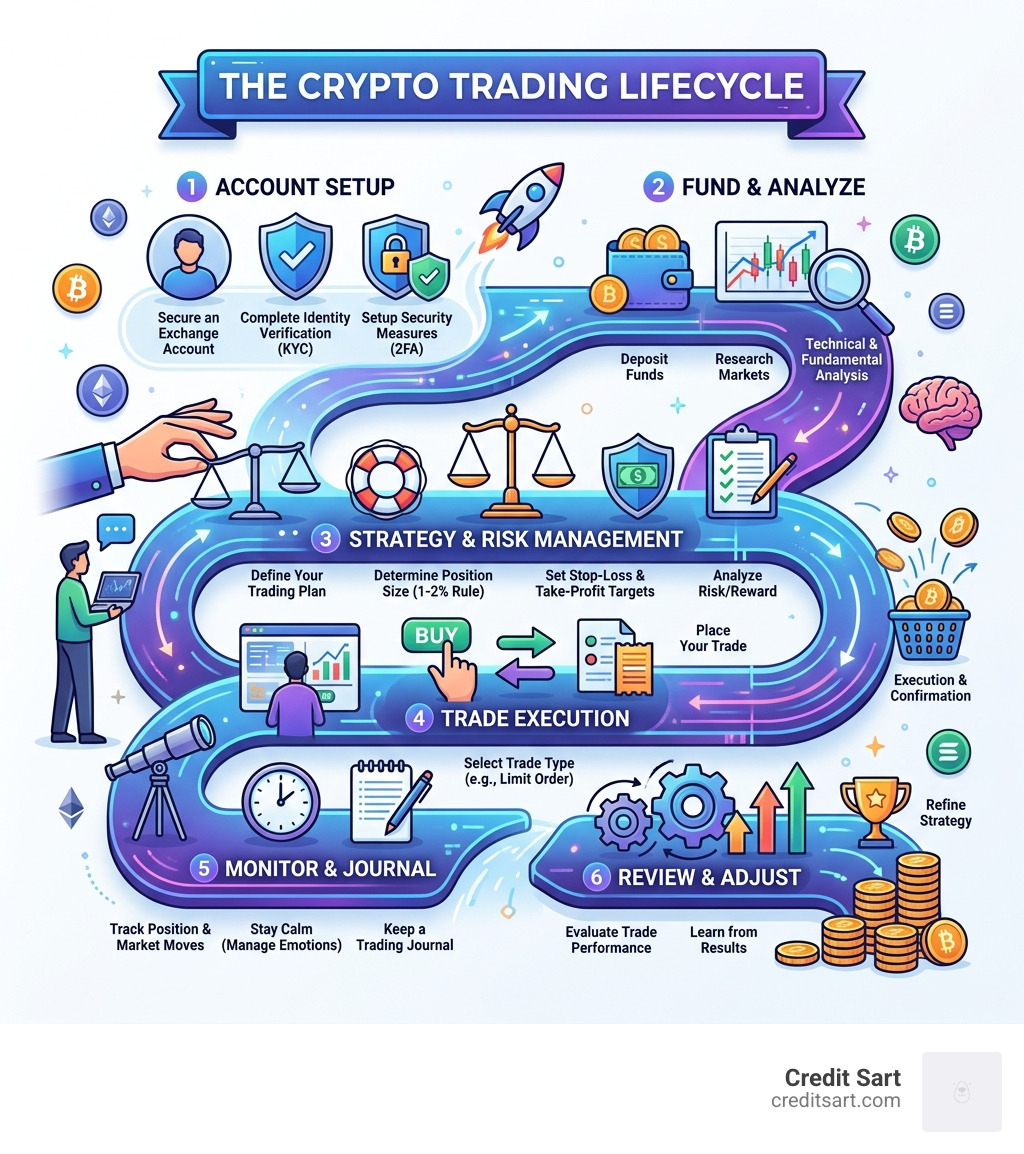
Crypto Trading vs. Investing: How the Market Works in 2026
Before we dive into the technical details, we need to clear up a common confusion: the difference between trading and investing. While both aim to make money, their methods are worlds apart.

Investing (The “HODL” Approach)
Investing is a long-term game. In the crypto world, this is often called “HODLing” (a term that famously originated from a forum typo but now stands for “Hold On for Dear Life”). Investors buy assets like Bitcoin or Ethereum because they believe in the underlying blockchain technology or its potential to become “digital gold.” They might hold for years, ignoring the daily price “noise.”
Trading (The Active Approach)
Trading is about speculating on price movements over shorter periods—ranging from minutes to months. Traders use spot trading to buy and sell actual coins, or derivatives to bet on price direction. Because the crypto market is decentralized and operates 24/7, it offers constant opportunities, but it also demands much more attention than passive investing.
| Feature | Crypto Trading | Crypto Investing |
|---|---|---|
| Time Horizon | Short to medium term (Days/Weeks) | Long term (Years) |
| Primary Tool | Technical Analysis (Charts) | Fundamental Analysis (Utility) |
| Risk Level | High (due to volatility) | Moderate (market cycle risk) |
| Goal | Profit from price swings | Long-term wealth accumulation |
One critical thing to understand in 2026 is liquidity. This refers to how easily you can buy or sell an asset without affecting its price. High-cap coins like Bitcoin have massive liquidity, while smaller “altcoins” might have thin order books, meaning a large sell order could crash the price instantly.
Scientific research on retail trading performance suggests that most short-term retail traders underperform because they lack a structured plan. At Credit Sart, we believe the key to avoiding this trap is understanding the mechanics of fiat-to-crypto gateways and how decentralized finance (DeFi) impacts the broader market.
Essential Crypto Trading Tips for Beginners to Start Safely
Security is the foundation of everything we do. In crypto, you are your own bank. If you lose your keys, you lose your money. There are no “forgot password” buttons for blockchain wallets.
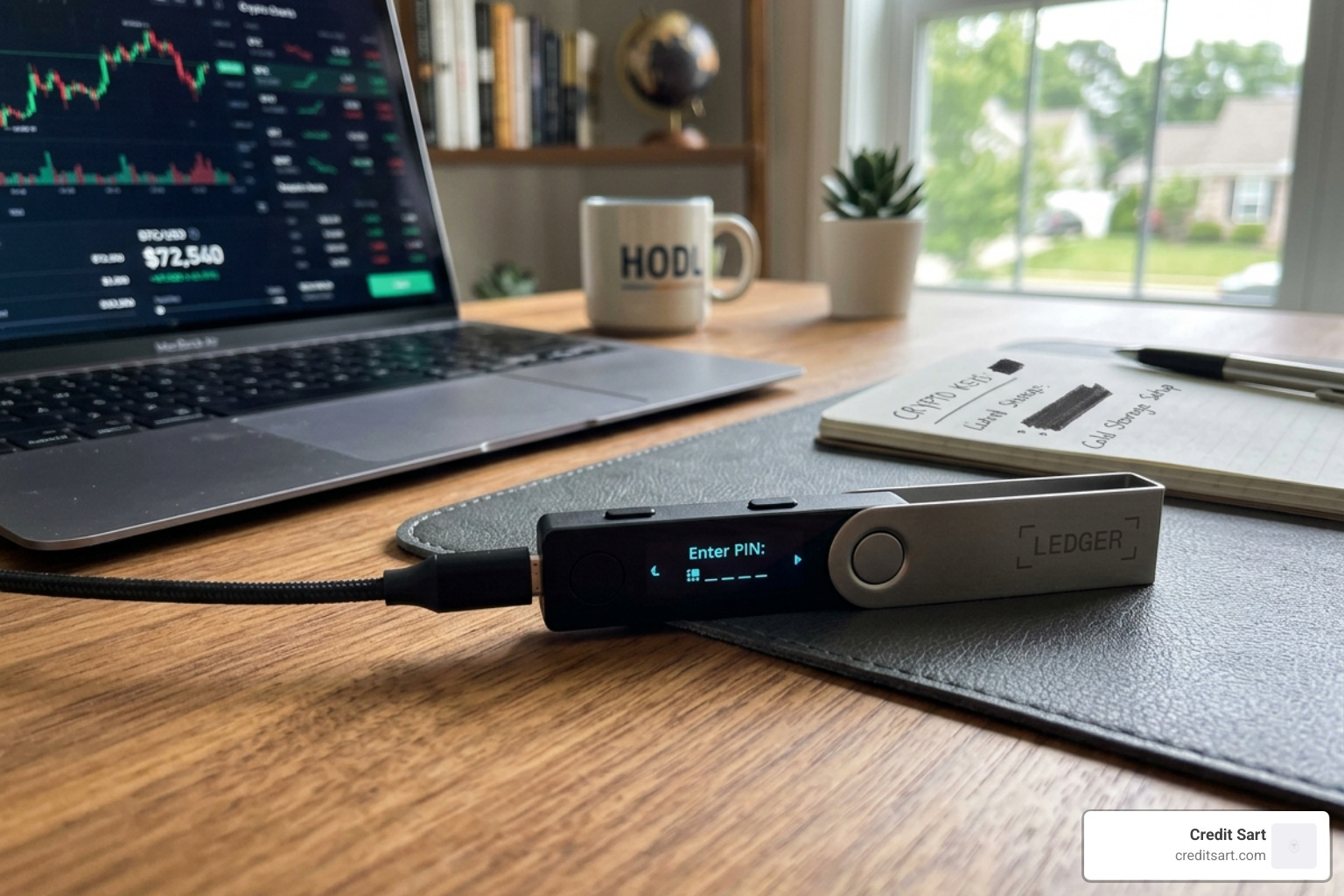
Choosing Your Platform
Your first step is selecting a reliable exchange. Look for platforms with high volume, a clean regulatory record, and mandatory KYC (Know Your Customer) verification. KYC might feel like a chore, but it’s a vital security layer that helps prevent fraud and keeps the platform compliant with local laws.
Ironclad Security Habits
- Two-Factor Authentication (2FA): Never use SMS-based 2FA. Hackers can “SIM swap” your phone number. Instead, use app-based authenticators or physical security keys.
- Cold Storage: For large amounts of crypto, use a hardware wallet. This keeps your private keys offline and away from hackers.
- Seed Phrases: When you set up a wallet, you’ll get a 12 to 24-word seed phrase. Write it on paper and hide it. Never store it on a computer or take a photo of it.
- Withdrawal Whitelisting: Enable this feature on your exchange. It ensures that crypto can only be sent to addresses you have pre-approved.
Starting Small with Fractional Investing
You don’t need $100,000 to trade. Most exchanges allow you to buy fractions of a coin. You can start with as little as $10 or $50. This allows you to learn the ropes without risking your life savings. For more info about crypto basics, we recommend starting with high-liquidity assets like Bitcoin before exploring the thousands of other tokens available.
Mastering the Market: Strategies and Analysis
To succeed, you need to move beyond “guessing.” Successful crypto trading tips for beginners always emphasize two types of analysis: Fundamental Analysis (FA) and Technical Analysis (TA).
Fundamental analysis involves looking at the “why.” Does the project solve a real-world problem? Who is the team? What are the tokenomics (the supply and demand mechanics)? On-chain data, such as the number of active wallet addresses or developer activity, can tell you if a project is actually being used or if it’s just hype.
Top Crypto Trading Tips for Beginners: Proven Strategies
Once you understand the fundamentals, you need a strategy. Here are the most effective ones for those just starting:
- Dollar-Cost Averaging (DCA): This is the ultimate “stress-free” strategy. You invest a fixed amount of money at regular intervals (e.g., $50 every Tuesday), regardless of the price. Over time, this averages out the volatility.
- Swing Trading: This involves holding a position for several days or weeks to capture a “swing” in the market trend. It’s great for beginners because it doesn’t require staring at charts all day.
- Range Trading: You identify “support” (the floor price) and “resistance” (the ceiling price) and trade between them.
- Event-Driven Trading: Trading based on news, such as a major upgrade or a change in federal regulations.
Technical Analysis and Crypto Trading Tips for Beginners
Technical analysis is the study of price charts and patterns. While it looks like a mess of lines at first, it’s actually just a visual representation of human psychology.
To get started, focus on these key indicators:
- Moving Averages (MA): These smooth out price data to show the trend. A “Golden Cross” (when a short-term average crosses above a long-term one) is often a bullish signal.
- Relative Strength Index (RSI): This tells you if an asset is “overbought” (over 70) or “oversold” (under 30).
- MACD: A momentum indicator that helps identify trend reversals.
- Bollinger Bands: These measure volatility. When the bands “squeeze” together, a big price move is usually coming.
- Volume: This confirms a move. If the price goes up on high volume, the trend is strong. If it goes up on low volume, it might be a “fakeout.”
Risk Management and Trading Psychology
If there is one section of this guide to memorize, it is this one. You can have the best strategy in the world, but without risk management, you will eventually hit zero.
The Golden Rules of Risk
- The 1-2% Rule: Never risk more than 1-2% of your total account balance on a single trade. If you have $1,000, you should only be prepared to lose $10 to $20 on a trade. This ensures that a string of bad luck doesn’t wipe you out.
- Stop-Loss Orders: This is an automated instruction to sell your asset if it hits a certain price. It’s your “emergency exit.”
- Take-Profit Targets: It’s easy to buy, but hard to sell. Decide where you will take your profits before you even enter the trade.
- Risk-to-Reward Ratio: Most pros look for at least a 1:2 ratio. This means for every $1 you risk, you aim to make $2.
The Psychology of the Trade
The latest data on crypto market volatility shows that prices can swing wildly based on a single tweet or news headline. This triggers two dangerous emotions: FOMO (Fear Of Missing Out) and the urge for revenge trading.
FOMO makes you buy at the top because you see everyone else making money. Revenge trading happens after a loss, when you try to “win it back” by taking a bigger, riskier trade. Both are recipes for disaster.
The best way to stay disciplined? Keep a trading journal. Write down why you entered a trade, what your plan was, and how you felt. Reviewing this weekly will show you patterns in your behavior that are costing you money.
Frequently Asked Questions about Crypto Trading
Can crypto trading be a primary source of income?
While professional crypto traders can generate monthly returns of 5% to 20%, it is incredibly difficult for beginners to do this consistently. Most successful traders start as a side hustle. There is a steep learning curve, and you need significant capital to live off the profits without over-leveraging yourself. Realistic expectations are key: focus on learning the skill first, and the income will follow.
Is crypto trading legal and how is it taxed?
In 2026, most countries have clear regulations for crypto. It is generally legal, but you are required to pay taxes on your gains. In many jurisdictions, every trade (even crypto-to-crypto) is a taxable event. We strongly recommend keeping meticulous records of your buy and sell prices. Using specialized tax software can save you hundreds of hours of headaches come tax season.
How do I choose the right cryptocurrencies to trade?
Focus on three things: Liquidity, Utility, and Roadmap. Stick to coins with high daily volume so you aren’t trapped in a position. Ensure the project has a clear use case and an active development team that hits their milestones. Avoid “meme coins” with no utility unless you are prepared to lose 100% of that investment.
Conclusion
At Credit Sart, our mission is to make digital finance “simple and smart.” Trading crypto doesn’t have to be a gamble. By following these crypto trading tips for beginners, staying disciplined, and never stopping your education, you can navigate this market with confidence.
Remember: the market will always be there tomorrow. Don’t rush, protect your downside, and start your crypto journey today with a clear head and a solid plan. Happy trading!
