
Crypto for Dummies and Future Millionaires
Why Every Beginner Needs a Crypto Guide Before Spending a Single Dollar
A beginner crypto guide is the single most important thing to read before you buy your first coin. Here’s what you need to know right now:
Quick-start crypto essentials:
- Cryptocurrency is digital money that runs on decentralized networks — no bank or government controls it
- Bitcoin and Ethereum are the safest starting points for beginners
- Buy on a reputable exchange (like Coinbase or Kraken) after completing identity verification
- Start small — most platforms let you begin with as little as $10–$50
- Secure your assets with two-factor authentication and a personal wallet
- Track every transaction from day one for tax purposes
Crypto has gone from a fringe experiment to a global financial force. Bitcoin has climbed roughly 12,000% since 2009. Ethereum has surged over 92,000% since 2015. As of early 2026, Bitcoin alone carries a market cap of $1.35 trillion.
Those numbers sound exciting. But the same market that made millionaires also wiped out unprepared investors overnight.
The difference between the two groups? Knowledge.
Most beginners don’t fail because the market is rigged against them. They fail because they rushed in without understanding the basics — how crypto works, where to buy it safely, how to store it, and what the tax rules are.
This guide fixes that. No jargon. No hype. Just clear, practical steps to help you get started with confidence.

Understanding the Basics: Your First Beginner Crypto Guide
At its heart, cryptocurrency is a form of digital payment that doesn’t rely on central banks to verify transactions. It is a peer-to-peer system that can enable anyone anywhere to send and receive payments.
So, how does it differ from the traditional money in your bank account? Traditional money (fiat) is issued by governments and managed by central authorities. When you swipe your debit card, a bank verifies that you have the funds. In crypto, we replace the bank with cryptography and a decentralized network of computers.
This means no single entity can freeze your account or print more money to devalue your savings. It’s “internet money” that belongs entirely to you.
How Blockchain Powers the Digital Economy
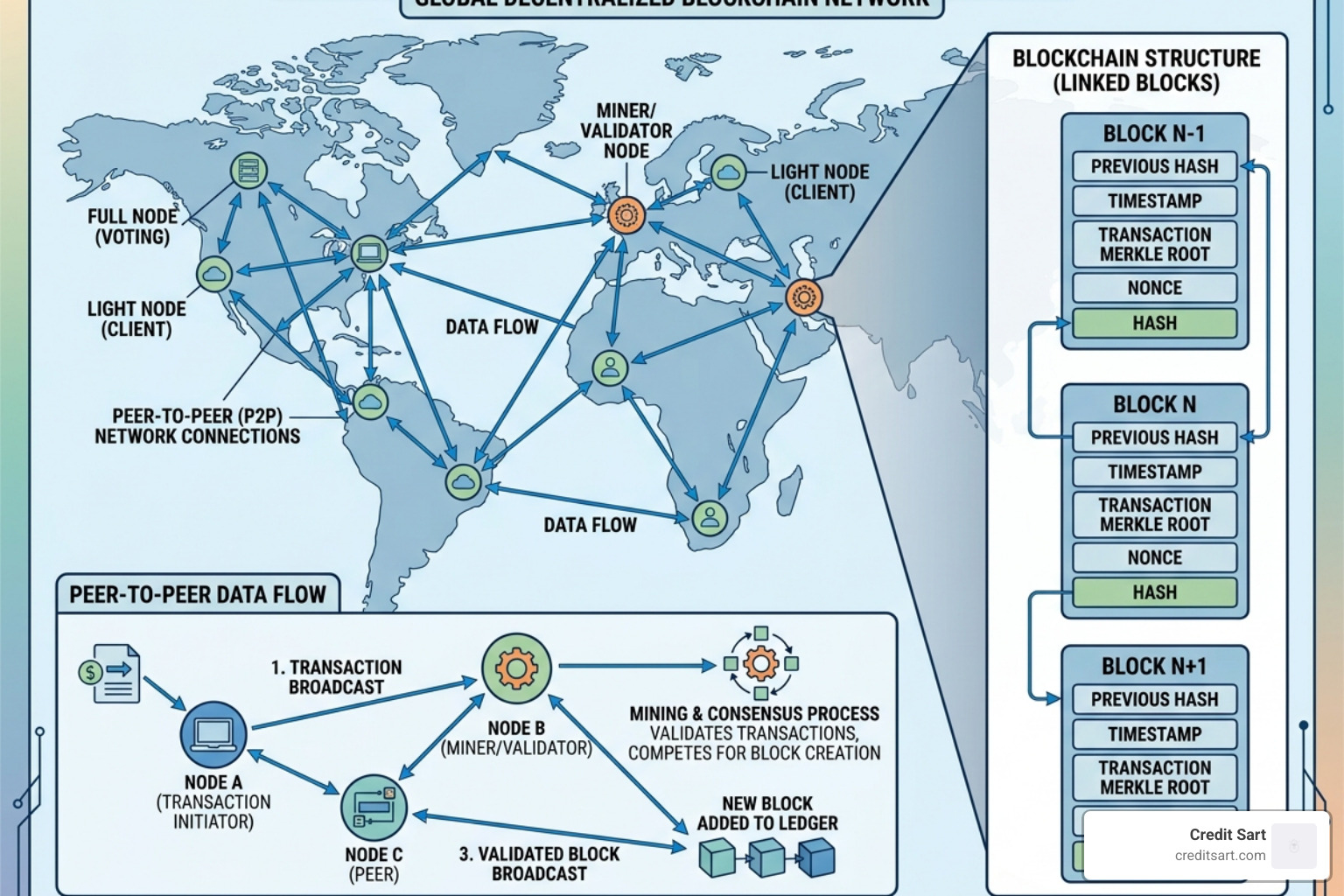
If cryptocurrency is the car, blockchain is the engine. A blockchain is a distributed, digital ledger that is shared among a network of computers (called nodes). Every time a transaction happens, it is grouped into a “block” and added to a permanent “chain.”
What makes this is that the ledger is tamper-proof. Once a block is added, it cannot be changed without altering all subsequent blocks, which would require the consensus of the entire network. This creates total transparency.
Furthermore, modern blockchains like Ethereum allow for smart contracts. These are self-executing contracts where the terms of the agreement are written directly into lines of code. They allow for complex financial transactions—like lending or insurance—without needing a middleman.
Why Crypto Has Value in 2026
You might wonder, “Why is a digital coin worth thousands of dollars?” In 2026, the value of crypto is driven by three main factors:
- Scarcity: Unlike the US Dollar, which can be printed indefinitely, many cryptos have a fixed supply. For example, there will only ever be 21 million Bitcoin.
- Utility: Some coins are used to pay for network services, while others act as “digital gold” or a hedge against inflation.
- Institutional Adoption: Major corporations now hold Bitcoin on their balance sheets, and mainstream financial institutions offer crypto services to their clients.
As of February 2026, the market cap for Ethereum stands at $237.4 billion, proving that these assets are no longer just “internet play money.”
The Crypto Landscape: From Bitcoin to Stablecoins
Navigating the thousands of available coins can feel like walking through a digital jungle. To make it simple, we categorize them into three main buckets:
| Feature | Bitcoin (BTC) | Ethereum (ETH) | Stablecoins (USDC/USDT) |
|---|---|---|---|
| Primary Use | Store of Value (Digital Gold) | Programmable Money/Apps | Stability/Payments |
| Technology | Proof of Work | Proof of Stake | Built on other chains |
| Volatility | High | High | Low (Pegged to $1) |
| Market Cap | ~$1.35 Trillion | ~$237 Billion | Varies |
A Beginner Crypto Guide to Major Assets
While Bitcoin is the king, you will often hear about altcoins (alternative coins).
- Ethereum (ETH): The second-largest crypto. It’s more than a currency; it’s a platform for thousands of other applications.
- Solana (SOL) & Cardano (ADA): Competitors to Ethereum that focus on faster speeds and lower costs.
- Stablecoins (Tether/USDC): These are the “safe harbors” of the crypto world. Their value is pegged 1:1 to a fiat currency like the US Dollar. They allow you to stay in the crypto ecosystem without worrying about price swings.
Understanding Gas Fees and Mining
Every time you move crypto, you have to pay a transaction fee, often called a “gas fee.” These fees pay the people (or computers) that secure the network.
In the early days, most crypto was created through mining. This is a process where powerful computers solve complex math puzzles to verify transactions. However, this is incredibly energy-intensive.
The Energy Reality:
- A single Bitcoin transaction requires approximately 1449 kWh. That is roughly equivalent to 50 days of power for the average US household.
- Large-scale operations are booming. For instance, a facility in Dalton, GA, uses 195 MW of power—matching the usage of 97,000 nearby households.
- Georgia has actually become the number two state for crypto mining in the US, following only Texas.
Because of these environmental impacts, many newer networks (and Ethereum) have switched to Proof of Stake, which uses 99% less energy by allowing users to “stake” their coins to secure the network instead of using massive computer rigs.

How to Buy, Store, and Secure Your Assets
Ready to take the plunge? Following this beginner crypto guide will help you avoid the most common pitfalls.
Steps to buy your first crypto:
- Choose an Exchange: Pick a reputable platform. Look for those with high security, clear fee structures, and regulatory compliance.
- Complete KYC: You will need to provide a photo ID. This “Know Your Customer” process is required by law to prevent fraud.
- Fund Your Account: Most beginners link a bank account or use a wire transfer. Avoid using credit cards, as banks often charge high fees for “cash advances.”
- Place an Order: Start with a “Market Order” to buy at the current price. We recommend starting with Bitcoin or Ethereum.
For more detailed help, you can check out Investing in Crypto Made Easy .
A Beginner Crypto Guide to Wallets
“Not your keys, not your coins.” This is a famous saying in crypto. If you leave your coins on an exchange, you don’t technically own them—the exchange does. To truly own your assets, you need a crypto wallet.
- Hot Wallets: These are apps on your phone or computer. They are convenient for frequent trading but are “hot” because they are connected to the internet, making them slightly more vulnerable to hacks.
- Cold Wallets (Hardware Wallets): These are physical devices (like a USB stick) that keep your “private keys” offline. This is the gold standard for security.
- Custodial vs. Non-Custodial: A custodial wallet (like an exchange) manages the keys for you. A non-custodial wallet gives you the seed phrase (a 12-24 word recovery code). If you lose that phrase, your money is gone forever. Never share your seed phrase with anyone.
Managing Risks, Taxes, and Investment Strategies
Crypto is exciting, but it is also risky. Prices can swing 10-20% in a single day. Here is how we recommend managing that:
- Dollar-Cost Averaging (DCA): Instead of “timing the market,” invest a set amount (like $50) every week or month. This smoothens out the price volatility over time.
- ETFs vs. Direct Ownership: In 2026, you can buy Bitcoin or Ethereum ETFs through a traditional brokerage account. This is easier for taxes and security, but you can’t use the coins to buy things or interact with the crypto ecosystem.
- Taxes: In the US, the IRS treats crypto as property. This means every time you sell, trade, or even buy a cup of coffee with crypto, it is a taxable event. Keep meticulous records of your “cost basis” (what you paid) and your sale price.
Frequently Asked Questions about Crypto
How much should a beginner invest in crypto?
We always say: only invest what you can afford to lose. Most experts suggest crypto should make up no more than 1% to 5% of your total investment portfolio. You don’t need to buy a whole Bitcoin! You can buy $10 worth of “Sats” (fractions of a Bitcoin) to get started.
Is cryptocurrency safe and legal in 2026?
In most developed nations, including the US, crypto is legal but regulated. Security has improved immensely, but scams are still out there. Always use Two-Factor Authentication (2FA)—and use an app like Google Authenticator rather than SMS-based 2FA, which can be hijacked.
What are the most common beginner mistakes?
- FOMO (Fear Of Missing Out): Buying a coin just because the price is skyrocketing. Usually, by the time you hear about it, it’s too late.
- Losing the Seed Phrase: Writing your recovery code on a piece of paper and losing it.
- Phishing Scams: Clicking links in emails that ask for your private keys. No legitimate company will ever ask for your keys.
Conclusion
At Credit Sart, we believe that the future of finance is digital, and our mission is to make that future simple and smart. Whether you are looking for the latest news, trading tips, or just a foundational education, we are here to help you navigate the complexities of the market.
The “Future Millionaires” aren’t the ones who get lucky on a meme coin; they are the ones who treat crypto as a serious, long-term asset class. By following this beginner crypto guide, you’ve already taken the most important step: educating yourself before putting your hard-earned money at risk.
Ready to take the next step? Start your smart crypto journey today and join the financial revolution with confidence.
